ZOOM ON A E18 NATIONAL TEAM THAT WON ABROAD
INTERVIEW OF A E18 ITALIAN TEAM THAT WON IN AUSTRIA
Recode the road - Winner, Bregenz-Hard-Fussach-Höchst (AT)
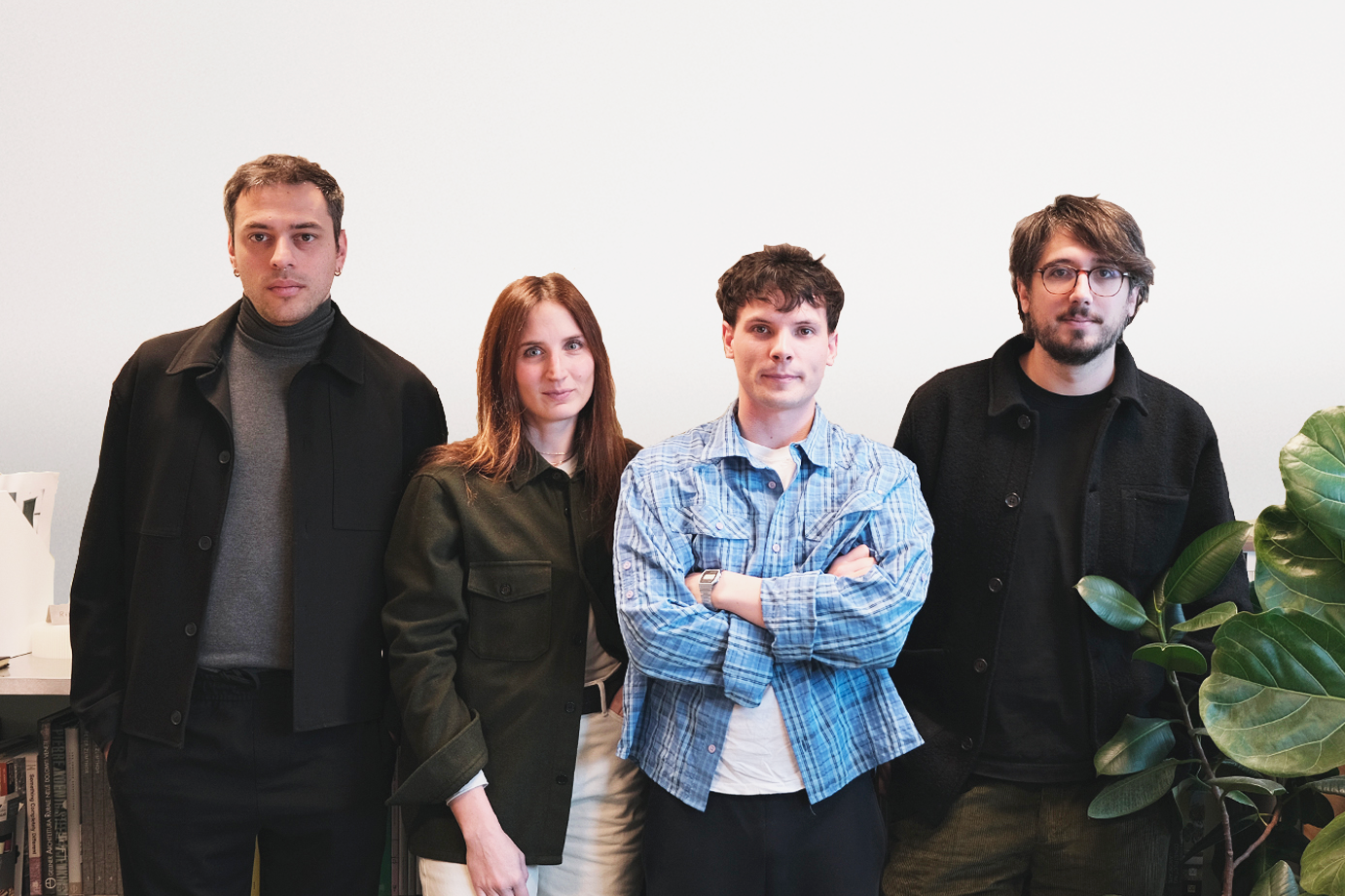
Associates: Luini Luca (IT) architect, Lorenza Sartori (IT) architect, Riccardo Masiero (IT) architect urbanist
Collaborator: Andrea Curti (IT) student in architecture
You chose to assemble a national team that won abroad – why did you make this choice?
For us, working as a national team abroad was a way to bring an already shared design culture into a different territorial and institutional context. Over the last years we have been developing projects that deal with infrastructures, fragile ecologies and everyday landscapes, mainly in Italy, and we were curious to test this experience against the very specific conditions of the Rhine delta and the L202 corridor. Europan offered an ideal framework to do this: on one side, the familiarity within the team allowed us to focus on the complexity of the site rather than on building internal routines; on the other, working in Austria meant confronting ourselves with another planning culture, other norms and expectations around infrastructure and landscape. At the same time, the Rhine delta and the Vorarlberg region are not completely abstract to us: they are part of the Alpine world, which remains a constant visual and physical horizon in our everyday life and practice. Working as a national team abroad allowed us to bring our shared experience on territorial projects into this wider Alpine landscape, using the competition as a bridge between familiar questions and a new, challenging context. We see this configuration as a productive form of displacement: it carries a common background and at the same time obliges us to listen carefully to local perspectives, which is extremely enriching for our practice.
How did you proceed?
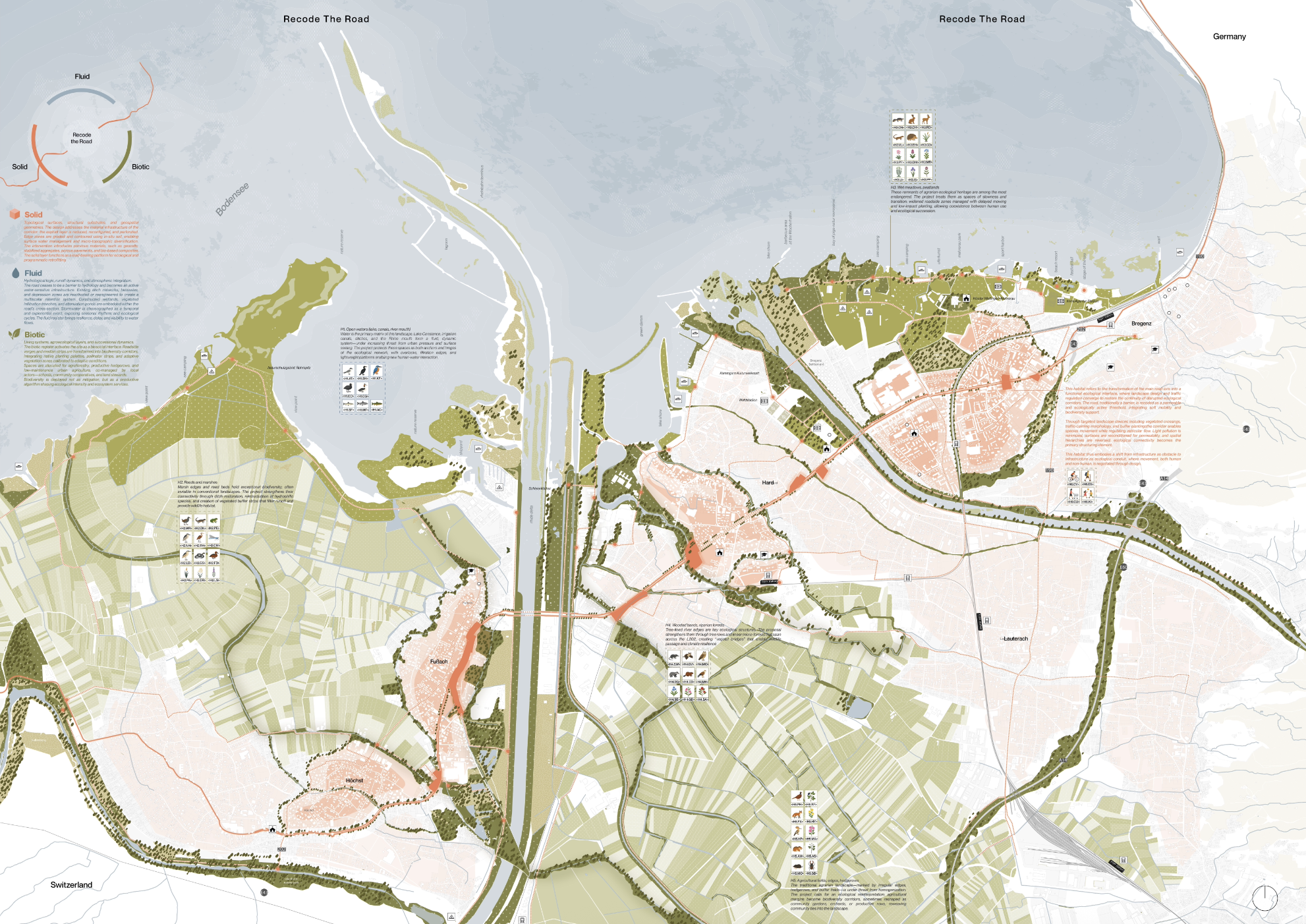
We approached Europan 18 with a methodology that is already quite consolidated within our practice, but this time we deliberately tested it on a territory we did not know directly. We started from a remote reading of the Rhine delta and the L202, using maps, data and aerial imagery to understand soils, water systems, settlement patterns and infrastructural logics. Not being locally rooted also became an opportunity: we could look at the corridor without preconceptions, focusing on how the different layers of the territory related to each other before focusing on specific projects or solutions. In this sense, our previous work on territorial projects gave us the minimal coordinates we needed: we already had tools to read the interplay between infrastructure, fragile ecologies and everyday landscapes, and we simply translated them to this new context. The solid / fluid / biotic framework emerged from this process as a way to keep the remote analysis, the cartographic work and the design of the nodes along the L202 within a single, coherent approach.
Had you worked together before?
Yes, we had already been working together for several years before entering Europan 18. After winning Europan 16 in Italy, we decided to consolidate our collaboration into a more structured practice, in order to carry the Europan projects forward and, at the same time, develop commissions and research in our local territories. Since then we have been working as a stable team on territorial strategies, ecological corridors, public spaces and architectural projects, often dealing with the relationship between infrastructure and landscape. In this sense, the E18 Recode the Road is not an isolated episode, but part of an ongoing conversation within the team about how to read and transform territories where mobility, water and everyday life intersect. For Europan 18 we built on this existing core and invited a younger collaborator to join the team, bringing a fresh perspective and additional energy to the process. This combination of a consolidated working structure and a new voice allowed us to focus on the specific context of the Rhine delta and the L202, while relying on a collaboration that had already been tested in both competition and implementation phases. In this sense, Recode the Road is not an isolated episode, but part of an ongoing conversation within the team about how to read and transform territories where mobility, water and everyday life intersect.
You will find their complete project here
Check out the Europan 18 results here